
A sample lesson on compound interest
Here is the free demo lesson on compound interest, step by step, in its real words. See what a lesson asks of you, and what you get back. You need no account to read it.
Last updated
Every lesson follows the same eight steps, in the same order, and skips any it does not need. This page walks through them with the free demo lesson.
The demo follows a script and marks answers by matching key words, so it is much cruder than the real tutor. What changes in your own lessons says how yours differ.
Boxes labeled Demo hold real text from the demo lesson's screens, with formulas in plain symbols. Some show only part of a screen. Boxes labeled Example answer were written for this page, then marked by the demo itself.
Rather try it than read it? Skip to the end.
1. Find your starting point
The lesson opens with three short questions, one at a time. They are not marked, and "I don't know" is a useful answer.
Demo · Starting point
- In your own words, what is interest on a savings account or a loan?
- You put $1,000 in a savings account paying 10% a year and leave it for 2 years. How much is there at the end, and how did you work it out?
- Roughly how long would it take for money to double at 8% a year?
The demo reads only your first answer. If it already explains interest, the plan shows where you're starting like this:
Demo · Where you're starting
You already have the basic idea of interest, so the lesson starts from how it accumulates.
- You already know: what interest is
- You'll learn: interest on interest, the compound formula, doubling time
Otherwise, it says: "We'll start from what interest is, then build up to how it accumulates."
In a real lesson, the tutor plans from all three answers.
2. Agree on a plan
Next you see the plan, with a title and a goal of its own. Below where you're starting, it lists the topic's small ideas, in an order where each builds on the last.
Demo · Your plan
How compound interest works
Understand why money grows faster and faster when interest compounds, and estimate it quickly.
- What interest is
- Simple interest
- Interest on interest
- The compound formula
- The rule of 72
Later in the course: Compounding more often
Under each idea is a sentence that states it, and its sources: links to the pages it rests on. Later ideas also name the ideas they build on. Here is the last one:
Demo · Plan: The rule of 72
At r% per period, money doubles in about 72 ÷ r periods.
Builds on The compound formula
Sources: Rule of 72 - Wikipedia
The demo's sources were chosen for it in advance.
You press Start the lesson, or Change the plan first. The demo's plan cannot change. Ask for changes, and it says so: "The demo plan can't change; a real lesson plans any topic your way."
3. Skip what you know
If your first answer already explains interest, the plan marks that idea "Quick check first". You get one question on it before any teaching:
Demo · Already know it?
A friend lends you $200 and asks for $10 back on top after a year. Explain what that $10 is, and what rate it represents.
A complete answer, given as "Fairly sure" or "Certain", skips teaching that idea. Otherwise it is taught like the others. The rest of this page follows a learner who is taught all five ideas.
4. Learn one idea at a time
Here is how the demo teaches the first idea, "What interest is", starting from a concrete case:
Demo tutor
Start with a concrete case. You lend a friend $200 for a year, and they give you back $210.
The extra $10 is interest: the price of using your money for that year. You couldn't spend or invest the $200 while they had it, so they pay you for the wait.
Interest is almost always quoted as a rate: a percentage of the amount, per period. Here, 10 / 200 = 0.05, so the rate is 5% a year.
A quick test of the idea: if your friend had borrowed $400 for a year at the same rate, how much interest would they owe?
Later ideas add a worked example, then your turn. This is the fourth idea, "The compound formula":
Demo tutor
Adding 10% to a balance is the same as multiplying it by 1.1. In general, adding a fraction r means multiplying by 1 + r.
So each year multiplies the balance by 1 + r, and after t years:
A = P(1 + r)ᵗ
Worked example. $1,000 at 10% for 3 years: 1000 × 1.1³ = 1000 × 1.331 = 1331.
Now you. $500 at 4% for 2 years: set up the formula, then work out the amount.
While an idea is being taught, you can reply or ask a question. In a real lesson, your tutor, an AI, answers you. The demo cannot, and it says so: "The demo lesson follows a script, so it can't answer what you write."
Show it interactively
For any idea, you can press Show it interactively to get an interactive picture. First you write a prediction, which is not marked.
Demo · Interactive picture: Simple vs compound interest
Before you touch anything: at 8% for 20 years, will compound interest end up a little ahead of simple interest, or far ahead? Roughly by how much?
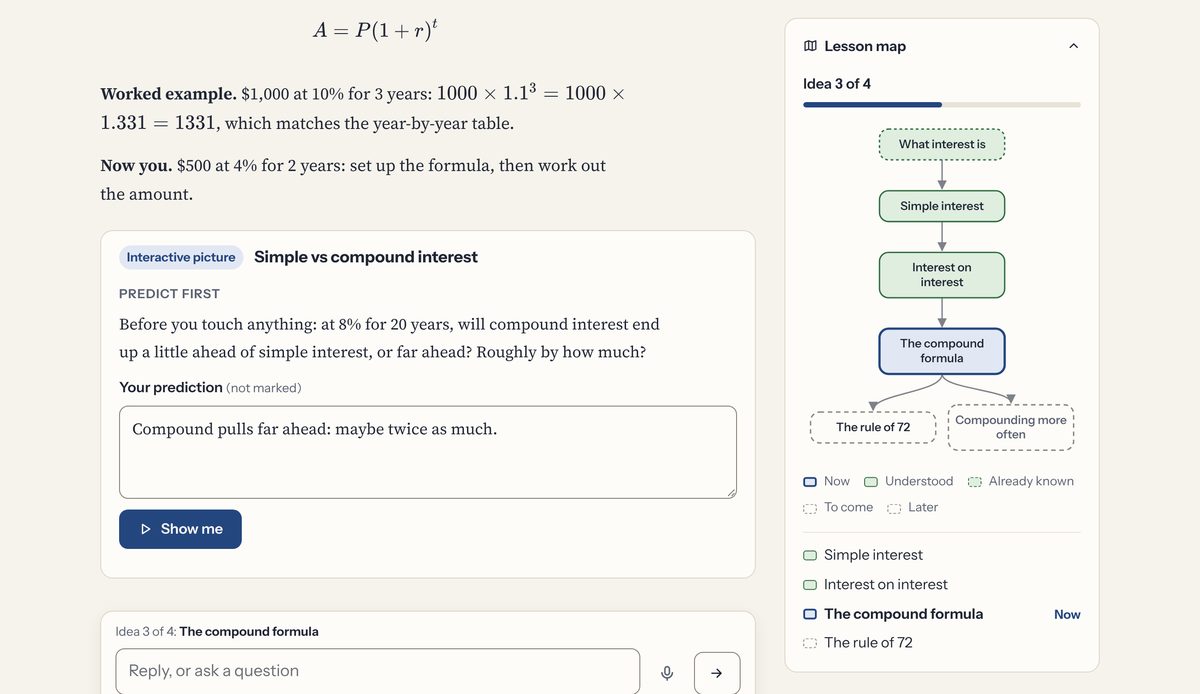
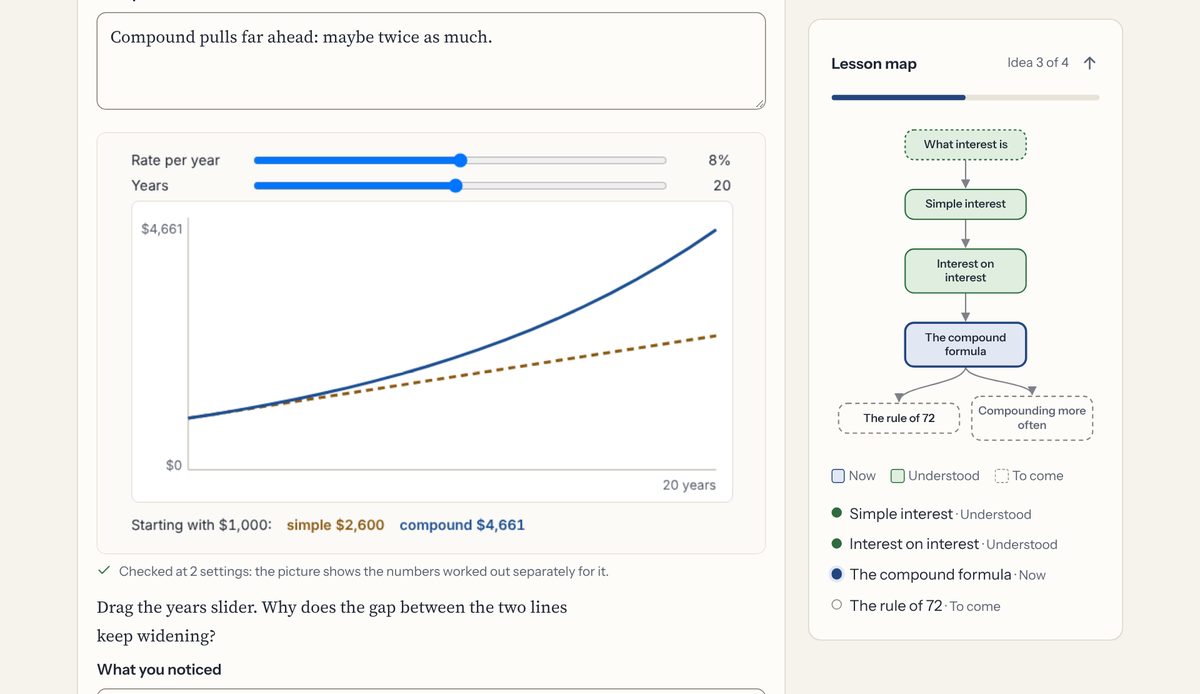
Then you press Show me. Before you see a picture, the app checks it. It sets the sliders to two settings and compares what the picture shows with numbers worked out separately for it:
- at 10% for 2 years, $1,200 simple and $1,210 compound;
- at 8% for 9 years, $1,720 simple and $1,999 compound.
A picture that fails goes back to be fixed. One that still fails is shown with a warning, never as checked. This one passes:
Demo · Interactive picture
Checked at 2 settings: the picture shows the numbers worked out separately for it.
Drag the years slider. Why does the gap between the two lines keep widening?
5. Check it in your own words
When an idea feels clear, you press Check my understanding. You get an open question, with no options to choose from. You write a few sentences and say how sure you are: Guessing, Unsure, Fairly sure or Certain.
Here is a check on the third idea, "Interest on interest":
Demo · Check: Interest on interest
Two accounts both pay 10% a year on $1,000. One adds the interest to the balance, the other pays it out to you. Why does the first end up ahead, and does the gap grow?
Example answer · Fairly sure
The first account adds the interest to the balance, so next year it earns interest on a bigger amount.
Demo · Marking
Not yet · 2 of 3 key points
You felt sure about this one and missed it. Corrections like this tend to stick.
Part of it is there. Still missing: So growth speeds up over time (exponential, not a straight line). (Demo grading looks for key words, so phrase things plainly; a connected AI grades meaning instead.)
- Covered: Interest is added to the balance
- Covered: The next interest is calculated on the new, larger balance
- Missing: So growth speeds up over time (exponential, not a straight line)
Not true: “Compound and simple interest end up about the same over long periods”
Marked by matching key words (demo)
For this idea, the demo shows a stock "Not true" line whenever a point is missed. In your own lessons, the tutor is asked to name a wrong belief only when your answer shows one.
Then the tutor explains the missing part again, from another angle:
Demo tutor
Picture a snowball rolling downhill: the bigger it gets, the more snow it picks up each turn. With compounding, the interest joins the balance, so next year 10% is taken of a bigger number; the yearly gain grows ($100, $110, $121, …) instead of staying flat.
Press Check my understanding when you're ready.
The next check is a new question:
Demo · Check: Interest on interest
Explain why the second year's interest is larger than the first year's when interest compounds.
Example answer · Fairly sure
The first year's interest is added to the balance. So the second year's interest is worked out on a bigger total, and the gain keeps growing.
Demo · Marking
Right · 3 of 3 key points
That's right, and it covers everything this question needed. (Demo grading looks for key words, so phrase things plainly; a connected AI grades meaning instead.)
- Covered: Interest is added to the balance
- Covered: The next interest is calculated on the new, larger balance
- Covered: So growth speeds up over time (exponential, not a straight line)
Marked by matching key words (demo)
After three tries on one idea, you can move on. The final check asks about it again, and a miss there brings it back sooner.
In your own lessons, the AI says which key points your answer covered, and the app works out the mark from that. In the demo, matching key words stands in for the AI.
6. Map it from memory
After the last idea, the lesson is hidden, and you see this:
Demo · Note
That's every idea for this lesson. Before the final check, write from memory how the ideas connect, from the basics up to the goal. The lesson so far is hidden until the mastery check is done.
Example answer · Map from memory
Interest is the price of using money, quoted as a rate. Simple interest is always worked out on the original amount. Compound interest adds the interest to the balance, so it grows faster. The formula is A = P(1 + r)ᵗ.
Demo · Marking
You recalled 4 of 5 ideas. Missing: The rule of 72. The chain runs: what interest is → simple interest → interest on interest → the formula → the rule of 72.
Marked by matching key words (demo)
Why hide the lesson? Looking back would turn recall into rereading, which does much less for memory. The lesson comes back after the final check.
7. A final check
Next come fresh questions, one on each idea you were taught, with the lesson still hidden. Round one asks these, one at a time:
Demo · Mastery check, round 1
- A shop offers to let you pay for a $600 sofa a year later if you pay $660 then. What is the extra $60, and what yearly rate is it?
- Sketch in words the graph of the balance over time for $1,000 at 6% simple interest. What does each year add, and why?
- Predict: after 30 years, will $1,000 at 7% compounded be about twice, or many times, what it would be with simple interest? Explain why.
- $500 at 8% a year compounded yearly for 3 years: what is the final amount? Show the formula.
- Your savings earn 6% a year. Estimate how long until they double, and say which rule you used.
An idea passes only when your answer covers all its key points. Ideas you miss get new questions, for up to three rounds. Any still missed after that are saved, and come back for review sooner.
8. Plan your practice
Each idea gets its first review date: the next day for one you found hard, and three days or more for one you knew well. Then you write a short plan for when you will practice.
Demo · Plan your practice
Picture the moment: “When …, I will …”. A plan made that concrete is easier to keep.
Buttons such as "After breakfast" and "Before bed" start the sentence for you.
A few days later: a review
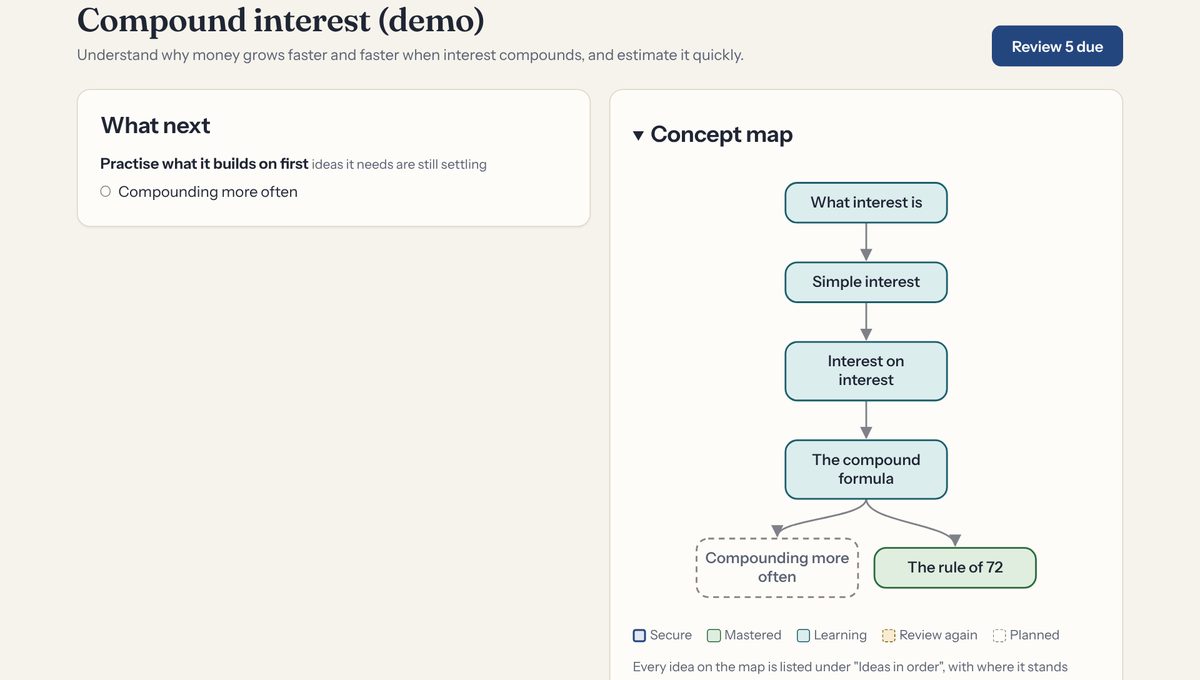
Your Today page shows the reviews that are due, with an estimate of how long they will take. Each one is a new question about one idea, answered from memory.
Demo · Review: The rule of 72
About how long does money take to double at 12% a year? Show the quick estimate.
Example answer · Certain
72 ÷ 12 = 6, so it doubles in about 6 years.
Demo · Marking
Right, and you were certain · The rule of 72
That's right, and it covers everything this question needed. (Demo grading looks for key words, so phrase things plainly; a connected AI grades meaning instead.)
- Covered: Doubling time is about 72 divided by the rate in percent
- Covered: Gives a sensible estimate for the case asked
Marked by the demo's key-word matching against the key points: 2 of 2 covered.
Every key point, and you were certain, so this idea waits longer before it comes back. A miss would bring it back sooner. Each next review is set for when your chance of recalling the idea falls to 90%, unless you choose another target in Settings.
If your allowance runs out, reviews carry on. You tick the key points your answer covered, against a model answer.
What changes in your own lessons
The steps, the checks and the review schedule stay the same. The tutor is different.
- You choose the topic. Your tutor, an AI, writes a plan for it, and you can ask for changes before you start.
- It may research your topic. To plan, the tutor may first search the web, and each idea links the pages it rests on.
- It answers you. Ask your own questions while an idea is being taught, and the tutor replies.
- Your answers are read for meaning. The AI says which key points your answer covered, and the app works out the mark. The AI can be wrong, and you always see which points counted.
- Pictures are made for your topic when you ask for one. The app checks each the same way before you see it.
- Lessons use your allowance. The demo never does.
Try it yourself
The demo lesson takes about 10 minutes. It is free, uses none of your allowance, and works before you confirm your email. It needs an account: you can start it from the welcome screen after you sign up, or from your Today page.
We're letting in a small group of early learners first. If you have an invitation, you can start today. To ask for an invitation, email help@thoughtpantheon.com.