
Thought Pantheon
Learn it. Know you learned it. Keep it.
Learn any topic you choose with a tutor, one small idea at a time. Explain each idea in your own words and see which key points you covered. Short reviews bring it back before you're likely to forget.
We're letting in a small group of early learners first. To ask for an invitation, email help@thoughtpantheon.com.
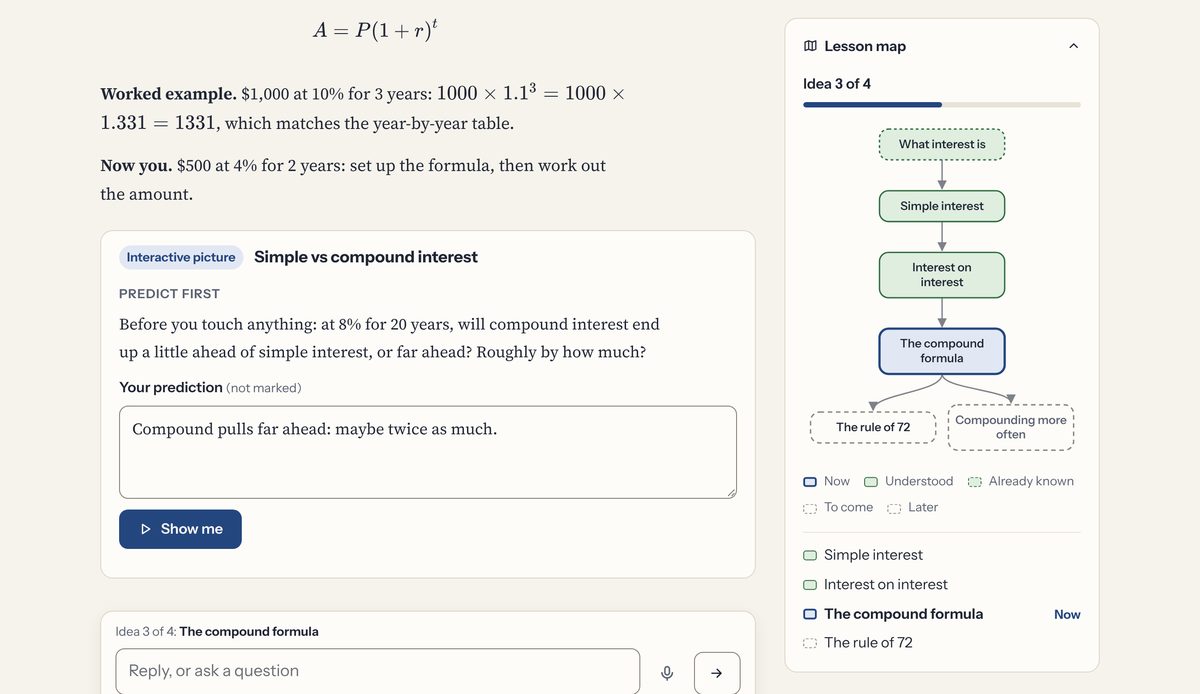
A chatbot explains. A tutor makes sure you learned it.
ChatGPT, Gemini and Claude have offered free study modes since the summer of 2025. They explain well, and some quiz you too. The tutor here is an AI as well, so the difference is not the explaining. It is the method around it:
- You agree on a plan. Your topic becomes small ideas, each building on the last.
- You explain each idea back in your own words, with no options to lean on.
- You finish with a final check. An idea passes only when your answer covers all its key points.
- Reviews help you keep it. Each idea comes back with a new question, before you're likely to forget it.
The app runs these steps in order, so the tutor cannot skip a check or call an idea learned early. Help has the longer answer.
What a lesson looks like
Here is how a lesson goes, with lines from the free demo lesson on compound interest.
- You start where you are. Three short questions, not marked, find your starting point: "Roughly how long would it take for money to double at 8% a year?"
- You see the plan first. The topic becomes small ideas, usually 4 to 7, and you can ask for changes. If you seem to know one already, one question lets you skip it.
- You learn one idea at a time. Ideas are taught with examples, such as the demo's first: "You lend a friend $200 for a year, and they give you back $210."
- You explain it back in a few sentences, and say how sure you are. There are no options to pick from: "Explain why the second year's interest is larger than the first year's when interest compounds."
- You see what counted. Every mark lists the key points your answer covered, so you can check it. A miss gets a fresh explanation and a new question.
- You pull it together. With the lesson hidden, you map how the ideas connect, then answer fresh questions on every idea.
- It comes back. Within a few days, your Today page asks something new: "About how long does money take to double at 12% a year? Show the quick estimate."
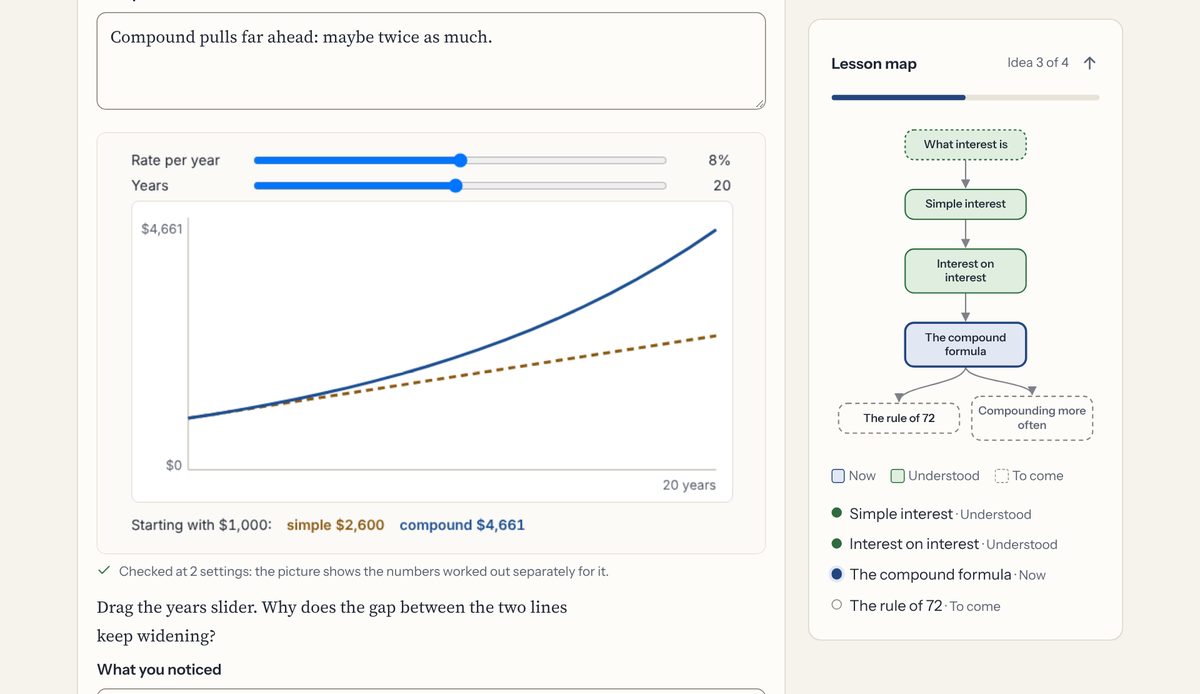
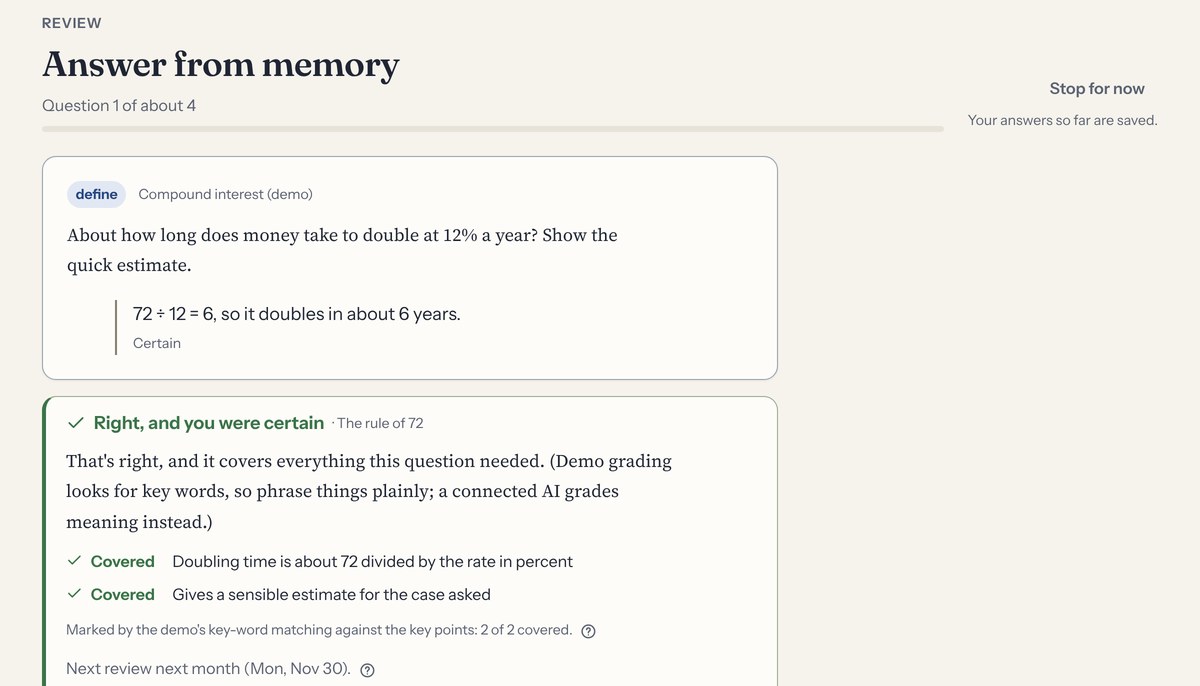
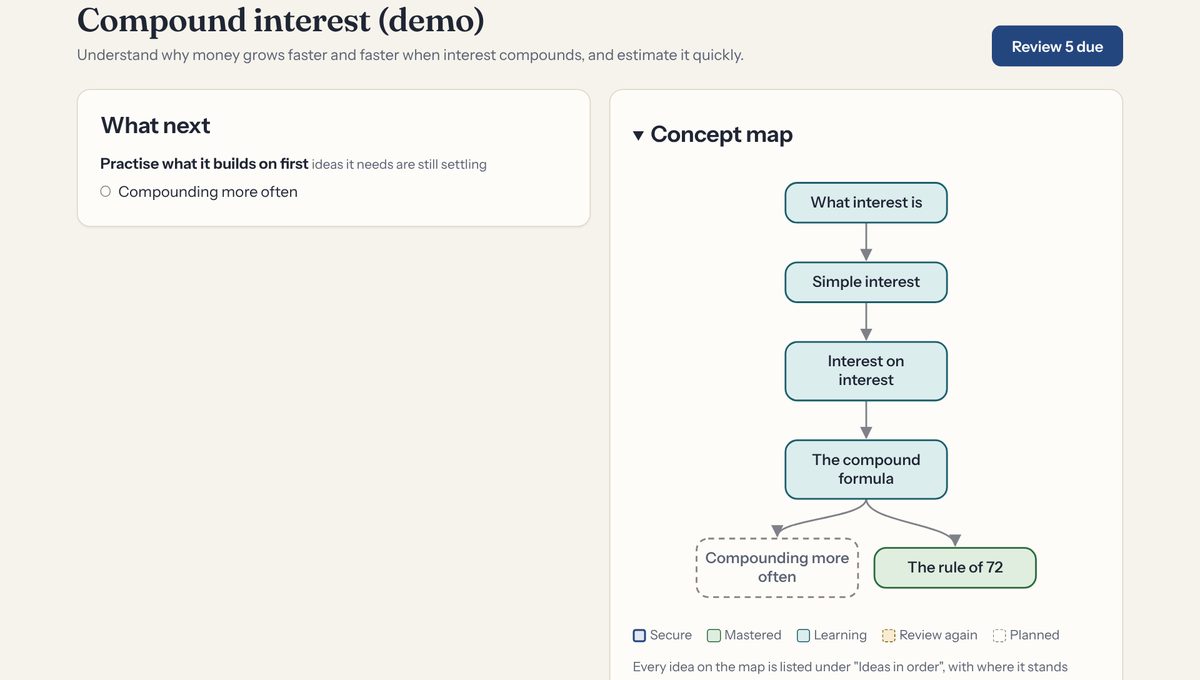
See the whole sample lesson, step by step, in the demo's real words.
The research behind the method
A 2013 review of ten study techniques rated only two as "high utility": practice testing and spaced practice. Rereading, highlighting and summarizing were rated low.
Thought Pantheon is built on those two. You answer from memory in every review and final check, and your reviews are spaced out over weeks. These are studies of the methods, not trials of this app. How it works lists the studies behind its main features.
Learning that takes effort often feels slower than reading, even when it works better. The questions are the point: recalling an idea does more for memory than reading it again.
Who built it
Thought Pantheon is built and run by James Perrotta, a data scientist who builds measurement systems. James's background is in natural language processing, psychometrics and industrial-organizational psychology.
That means the marking was designed by someone who does assessment for a living. Each question's key points are set before you answer, and you always see which ones counted. The founder's note says why Thought Pantheon was built.
Start free. Cancel any time.
- Start free. Confirm your email and you get 1 lesson of tutoring for 14 days.
- No card needed. The trial never turns into a paid plan on its own. When it ends, it simply ends.
- One plan. $19 a month, in US dollars, for 16 lessons of tutoring.
- Cancel any time from Plan & usage. Your plan runs to the end of the month you paid for, and nothing more is charged.
- Refunds. Ask within 14 days of a payment, with at least three quarters of its allowance unused, and we refund the whole payment. To ask, email help@thoughtpantheon.com.
- Only the charges you choose. You are never charged for using more than you bought.
- Your reviews keep going. If your allowance runs out, lessons pause, but reviews carry on, marked by you.
- Your data stays yours. We do not sell it or use it for advertising. You can download it, or delete your account, at any time.
Pricing has the details, including top-ups.
The AI writes. The app decides.
The tutor is an AI, not a person. Its words come from Anthropic Claude. Lessons call it "Tutor" and say at the start of each lesson that it is an AI. It writes the explanations, questions and feedback, and says which key points your answer covered. It can be wrong, so check anything that matters.
The app decides each next step, your mark and your review dates. So the AI cannot skip a check, call an idea learned early or change a mark. The app checks each interactive picture's numbers before you see it, but not whether a fact is true. About the AI has the details.
Is it right for you?
Good for
- Ideas that build on each other, such as statistics, a programming language, economics or music theory.
- Understanding something well enough to explain it, not just finding it familiar.
- Keeping what you learn, with short reviews spread over weeks.
Not for
- Decisions where a mistake could hurt someone, such as medical, legal, financial or safety questions.
- Certificates or proof of learning. It gives none.
- Very recent events, or facts you need exactly right without checking them.
- Quick answers. A lesson asks you to think and write.
Thought Pantheon is for adults, 18 and over, in the United States.
We're letting in a small group of early learners first. If you have an invitation, you can start today. Anyone can read the sample lesson. To ask for an invitation, email help@thoughtpantheon.com.
Last updated